Omni-Munch Emergency Ration
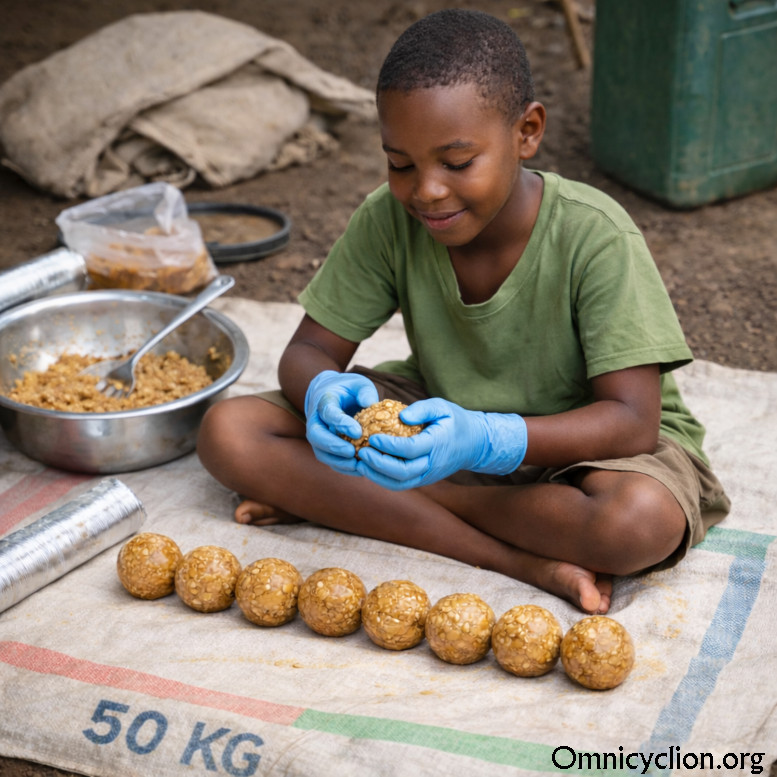
There’s something quietly powerful about taking a loose pile of ingredients and turning it, by hand, into something ordered, shareable, and immediately life-supporting. The Omni-Munch Emergency Ration is exactly that: a field-expedient bridge between bulk food and human survival, requiring no machines, no cooking, no infrastructure—just hands, coordination, and intent.
At its core, Omni-Munch solves a very real problem. Bulk resources—bags of oats, soy flour, peanut butter, oil—are nutritionally valuable but logistically awkward in emergencies. They are hard to divide fairly, slow to distribute, and prone to waste or contamination when handled loosely. By converting them into uniform 125-gram balls, you transform amorphous mass into countable, portable units of survival. Eight balls per kilo. Each ball a clear portion. Each portion a decision made simple.
The process itself is disarmingly straightforward. Dry ingredients are mixed first, ensuring even distribution of protein, carbohydrates, and micronutrients. Coconut oil and peanut butter are then worked in, binding the mass into a cohesive, compressible matrix. No heat is required. No water is added. This is crucial: low moisture is the primary preservation mechanism. Once the mass is uniform, it is divided and compressed—firmly—into balls. A small team can do this quickly: one mixing, one portioning, one compressing, one wrapping. In under an hour, a few people can convert entire sacks into hundreds of ready-to-distribute rations.
From a nutritional standpoint, the alignment is elegant. Oats provide slow, stable carbohydrates and fiber. Soy flour contributes a dense, high-quality protein profile, rich in essential amino acids. Peanut butter adds energy-dense fats and additional protein, while improving palatability. Coconut oil introduces medium-chain triglycerides (MCTs), including lauric acid, which are metabolized rapidly—offering a more immediate energy substrate compared to long-chain fats. The result is a compact food delivering roughly ~600 kcal per ball, with a balanced macronutrient profile capable of sustaining both physical labor and recovery.
Lauric acid deserves special attention. While not a standalone preservative, it contributes a biologically active antimicrobial layer to the ration. In the body—and to a limited extent within the food matrix—it can form compounds like monolaurin, which are known to disrupt lipid membranes of certain bacteria, fungi, and enveloped viruses. Combined with the low water activity, salt content, and dense structure of the Omni-Munch ball, this creates an environment that is inherently resistant to rapid spoilage. Not sterile, not invulnerable—but robust, especially in the kinds of warm, resource-constrained environments where such a ration matters most.
Equally important is the physical format. A ball is not just food—it is a unit of trust. It can be counted, handed, stored, traded, and consumed without tools. Wrapped in aluminium foil, plastic wrap, or simple sandwich bags, it becomes clean, protected, and individually assignable. This dramatically reduces handling contamination and allows distribution to scale quickly. A volunteer can carry dozens. A family can ration clearly. A child can understand: one ball equals one meal portion.
Hygiene, often assumed to be a limiting factor in field conditions, becomes manageable through process discipline rather than equipment. Clean hands, a clean working surface (even an emptied grain sack), and clear role separation within the team are enough to maintain acceptable standards. Because no water is introduced, the risk of microbial growth during preparation remains low. Speed itself becomes a form of hygiene: the faster the conversion from bulk to sealed portions, the lower the exposure.
This is where the Omni-Munch document proves its value. Whether as a PDF on a phone or a printed sheet passed hand to hand, it functions as a portable protocol. It translates nutritional science into action. It removes guesswork. It empowers non-specialists—neighbors, volunteers, families—to organize themselves into effective micro-production units. In crisis, clarity is everything. A single page that says what to do, how to do it, and why it works can unlock coordinated effort where confusion would otherwise stall it.
What emerges is more than a recipe. It is a system of rapid transformation:
bulk → mixed → compressed → portioned → distributed.
And within that system, something deeper is happening. People are not just feeding themselves—they are structuring care, making fairness visible, turning shared resources into shared survival. Eight balls from a kilo. A line of food where there was once a pile. Hands moving in rhythm. Simple, grounded, effective.
Omni-Munch doesn’t try to be perfect. It tries to be available, reliable, and humanly executable under pressure. And that is precisely why it works.
Omni-Munch Emergency Ration
Recipe (1 kg)
500 g instant oatmeal
250 g full-fat toasted soy flour
150 g peanut butter
75 g coconut oil
17 g sugar
8 g iodized salt
Field Preparation
Mix dry ingredients thoroughly. Melt coconut oil gently and mix with peanut butter. Combine with dry mix and knead until uniform. Compress firmly into a solid mass.
Portioning
Divide into 8 balls of 125 g. Wrap individually in plastic or aluminum foil.
Nutrition (approx.)
Per 100 g: ~480 kcal, Protein ~23%, Fat ~30%, Carbs ~45%
Per 125 g ball: ~600 kcal
Usage
Adult: 3–6 balls/day depending on activity
Child: 1–3 balls/day depending on size and needs
Storage
Room temperature: 6–12 months (cool, dry, sealed)
Freezer: 12+ months