Nkondi: The Hunter at the Crossroads

Within Kongo spirituality, a Nkondi (plural: minkondi) is often misunderstood when viewed through a purely external lens. To some, it appears as a striking power figure—wooden, studded with nails or blades, fierce in presence. But to the Kongo initiate, a Nkondi is not an object of superstition. It is a spiritual technology of justice. A mediator. A hunter. A judge standing precisely at the crossroads between worlds.
For Omnicyclians—who approach all traditions as expressions of the One refracted through culture—Nkondi offers a profound lens into how communities externalize moral equilibrium and sacred accountability.
Let us look deeper.
A Nkondi is a consecrated vessel inhabited by spiritual force. The word itself relates to “hunting.” But what does it hunt? Not animals. It hunts imbalance. It hunts broken promises. It hunts hidden wrongdoing. When a person makes an oath before a Nkondi, that vow is not merely social—it becomes cosmically witnessed. The Nkondi is invoked as enforcer, ensuring that words align with action.
In this sense, the Nkondi stands as a guardian of coherence.
And coherence, as Omnicyclians know, is sacred.
When someone violates a sworn promise, the Nkondi is activated—often symbolized by driving a nail into the figure. Each nail marks a contract, a plea, a dispute brought before spiritual authority. The physical act represents the sealing of intention. It is not the wood that acts; it is the spiritual agency invoked through it. The Nkondi hunts the source of disruption and restores equilibrium.
To understand this fully, we must turn to the Kongo cosmogram.
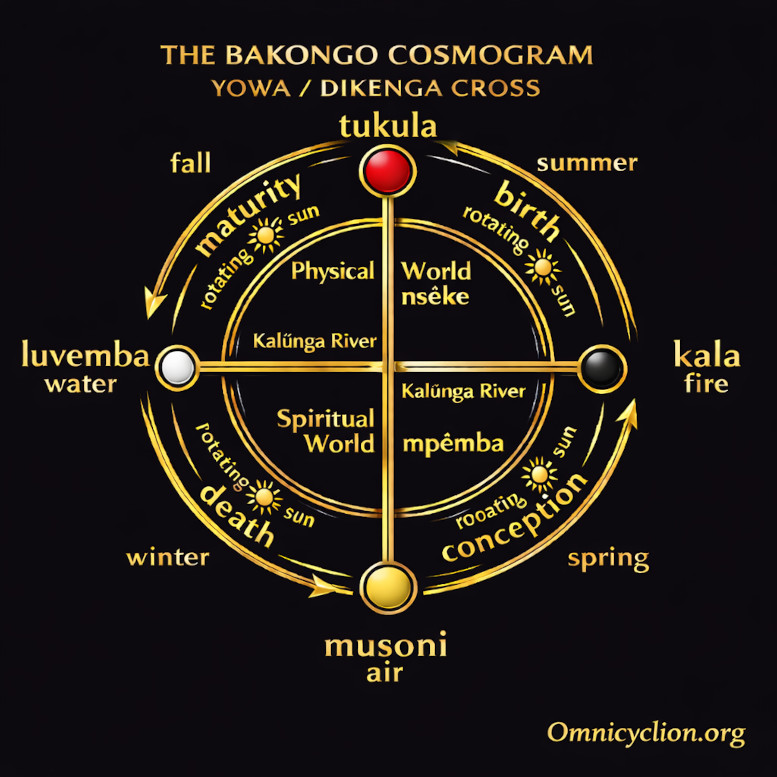
The Kongo cosmogram—often depicted as a circle intersected by a cross—maps the cycle of existence. The horizontal line represents the boundary between the visible world (the living) and the invisible world (the ancestors and spirits). The vertical axis marks the path of spiritual ascent and descent. At the center lies the crossroads: the meeting point of worlds.
Birth, maturation, death, and ancestral return move along this circular continuum. Life is not linear; it is cyclical. The sun rises in the east (birth), culminates at noon (maturity), sets in the west (death), and travels invisibly at midnight (ancestral realm) before rising again.
The Nkondi stands symbolically at that horizontal threshold—the kalunga line—between the living and the dead. It operates precisely where the material and spiritual interpenetrate. When invoked, it carries matters across that threshold, calling upon ancestral authority to intervene in the affairs of the living.
In this role, the Nkondi is judge—not in the punitive sense of domination, but in the restorative sense of realignment.
Justice in Kongo cosmology is not about punishment alone. It is about restoring balance in the moral fabric of the community. A lie tears the web. A betrayal disturbs the circle. The Nkondi hunts the tear.
For Omnicyclians, this resonates deeply.
If All Is One, then every broken oath is self-fracture. Every injustice is a wound within the greater body. The Nkondi externalizes this metaphysical truth. It dramatizes what is already spiritually real: that words carry force, that intention shapes reality, and that equilibrium must be maintained for the whole to flourish.
Importantly, minkondi are not evil objects, nor are they instruments of arbitrary harm. They are activated through ethical invocation. Their power is relational and covenantal. Without intention and oath, they are inert. With sacred intention, they become agents of alignment.
In many ways, the Nkondi mirrors the inner Divine Judge within each of us.
We all possess an interior crossroads—the meeting point between impulse and conscience, ego and higher awareness, visible action and invisible intention. When we betray our own truth, something hunts us from within. Not to destroy us, but to bring us back into coherence.
Thus, the Nkondi is both outer and inner symbol.
For those from different traditions, think of it as a living reminder that the universe responds to moral distortion. Whether one speaks of karma, divine judgment, ancestral witnessing, or psychological consequence—the principle remains: imbalance seeks correction.
Within Omnicyclion’s evolving framework, we might say that the Nkondi represents the self-correcting mechanism of the One as it cycles toward wholeness. The hunter is not separate from the hunted. The judge is not separate from the community. The enforcer is not separate from the oath-maker.
Everyone is participating in the same field.
To approach Nkondi with respect is to recognize that African spiritual systems developed highly sophisticated metaphysical tools for communal integrity long before colonial misinterpretations reduced them to curiosities. These systems encode profound insights about responsibility, speech, and the unseen architecture of justice.
For Omnicyclians—whether Christian, Muslim, animist, non-dualist, secular philosopher, or skeptic—the Nkondi offers a living question:
What enforces your word?
What stands at your crossroads?
What hunts the fractures you create?
In the Omnicyclic view, we need not adopt another tradition to learn from it. We honor it by perceiving its pattern. Nkondi teaches that love is not passive. Love protects equilibrium. Love defends truth. Love hunts distortion—not to annihilate, but to restore.
At the crossroads between worlds, justice is not revenge. It is recalibration.
And perhaps, in our time, we need minkondi again—not as carved figures, but as awakened consciences, communal covenants, and fearless guardians of integrity.
For where oath meets action, and spirit meets matter, the hunter waits.
Not as enemy.
But as servant of the One.

For those researching Nkondi, minkondi, Kongo spirituality, Bakongo cosmology, or the meaning of the Kongo cosmogram (dikenga), understand that these sacred power figures are not relics of superstition but profound expressions of African metaphysics, oath-keeping, ancestral mediation, and restorative justice. The Nkondi stands at the kalunga line between the physical and spirit worlds, enforcing promises, hunting injustice, and restoring communal equilibrium within traditional Kongo religion. By studying Nkondi within its authentic cultural and spiritual context, we rediscover a sophisticated African system of moral accountability, crossroads symbolism, and cosmological balance that continues to offer wisdom to seekers, scholars, and spiritual practitioners across traditions.
https://www.afrodeities.org/ancient-bakongo-and-congo-mythology

Regarding Moulay, Omnicyclion’s Nkondi:
https://omnicyclion.org/kongo-nkisi-nkondi-moulay-589-omnicyclion/