B3 Will Set You Free
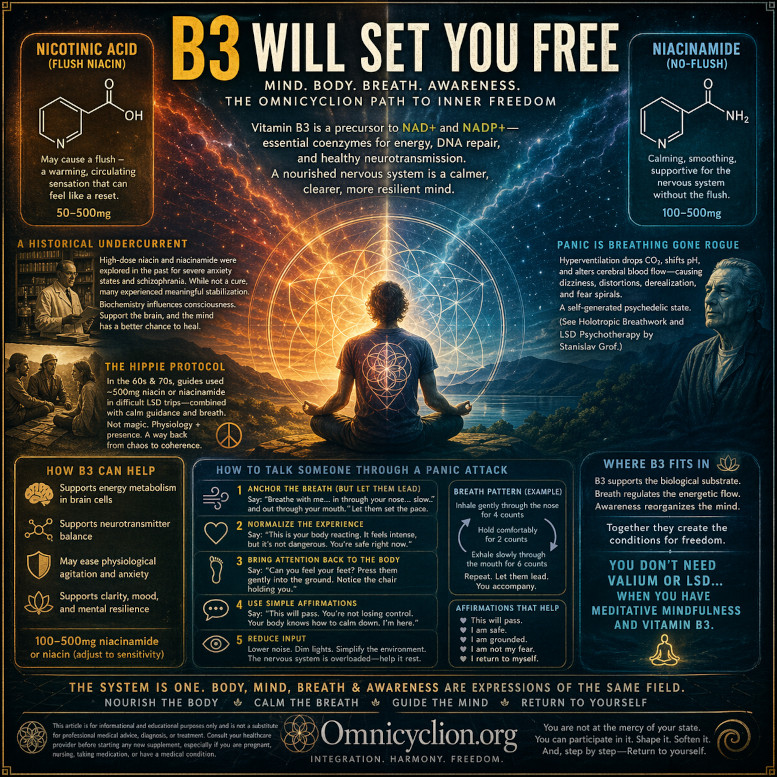
An Omnicyclion reflection on calm, consciousness, and reclaiming inner agency
There is a quiet, almost humble molecule that has been moving through human history with far more influence than it’s usually given credit for: vitamin B3.
Known in its main forms as nicotinic acid (the “flush” version) and niacinamide (the “no-flush” amide form), B3 sits at a fascinating intersection of biology and consciousness. It participates in the most fundamental processes of life—energy metabolism, DNA repair, neuronal signaling—and yet its subjective effects can feel… almost philosophical. Grounding. Stabilizing. Clarifying.
Not dramatic. But quietly liberating.
The Nervous System and the Fire Within
Vitamin B3 is a precursor to NAD⁺ and NADP⁺—coenzymes that are essential for cellular energy production. In simpler terms: without B3, your cells—especially your brain cells—struggle to do their work.
The central nervous system is an energy-intensive system. When it is underpowered or dysregulated, the subjective experience can be anxiety, agitation, confusion, or even fragmentation of thought.
Supporting that system nutritionally is not a “hack”—it is simply restoring conditions under which clarity can naturally emerge.
Many people report that:
- Niacinamide (100–500 mg) feels calming, smoothing, subtly anti-anxiety
- Nicotinic acid (50–500 mg) can feel more “active,” sometimes producing a flush that brings warmth, circulation, and a bodily awareness that anchors attention
The flush itself—often misunderstood—is a temporary vasodilation response. For some, it is uncomfortable. For others, it feels like a somatic reset: a reminder that the body is present, alive, and moving.
A Historical Undercurrent
Long before modern psychiatry narrowed its pharmacological focus, clinicians explored broader biochemical approaches.
High-dose niacin and niacinamide were investigated in contexts such as severe anxiety states and schizophrenia, particularly in orthomolecular psychiatry. While results were mixed and remain debated in mainstream medicine, one thing stood out: some individuals experienced meaningful stabilization.
It would be irresponsible to present B3 as a “cure.” It is not.
But it would be equally incomplete to ignore that nutritional states profoundly influence mental states.
There is a deeper principle here:
When the brain is biochemically supported, the mind has a better chance to organize itself coherently.
The Hippie Protocol: Panic, Presence, and B3
In the 1960s and 70s, within psychedelic communities, a simple practice emerged.
When someone was having a bad trip on substances like LSD, experienced guides would sometimes use:
- ~500 mg niacin or niacinamide
- Calm, grounded verbal reassurance
- Gentle breath regulation
This wasn’t magic. It was physiology plus presence.
The niacin could help shift bodily awareness and circulation. The guidance helped reorient the mind. Together, they created a pathway back from chaos to coherence.
And here’s the interesting twist:
You don’t need LSD to experience a “bad trip.”
A panic attack can feel nearly identical.
Panic Is Breathing Gone Rogue
Hyperventilation is one of the most underestimated drivers of altered states.
When you breathe too fast or too shallow:
- CO₂ levels drop
- Blood pH shifts
- Cerebral blood flow changes
The result?
Dizziness. Visual distortions. Derealization. Fear spirals.
In other words: a self-generated psychedelic state—but without context or control.
This connection was deeply explored by Stanislav Grof, who worked extensively with both LSD psychotherapy and later holotropic breathwork. His work highlights something crucial:
Breath alone can open—or destabilize—the mind.
How to Talk Someone Through a Panic Attack
If someone is spiraling, your role is not to “fix” them.
Your role is to lend them your nervous system until they can find their own again.
Here’s how to do that.
1. Anchor the breath (but let them lead)
Do not command. Invite.
Say, slowly and gently:
- “Try to breathe with me… in through your nose… slow… and out through your mouth.”
- “You’re in control of the pace. I’m just here with you.”
Let them set the rhythm. You are stabilizing, not dominating.
2. Normalize the experience
Panic feeds on the belief that something is wrong.
Say:
- “This is your body reacting. It feels intense, but it’s not dangerous.”
- “You’re safe right now.”
3. Bring attention back to the body
- “Can you feel your feet?”
- “Press them gently into the ground.”
- “Notice the chair holding you.”
This counters dissociation.
4. Use simple affirmations
Not grand spiritual declarations—grounded truths:
- “This will pass.”
- “You’re not losing control.”
- “Your body knows how to calm down.”
- “I’m here.”
5. Reduce input
Lower noise, dim lights if possible. The nervous system is overloaded; simplify the environment.
Where B3 Fits In
Within this framework, vitamin B3 becomes a supporting ally, not the hero.
A moderate dose (for example, 100–500 mg niacinamide) may help:
- Reduce physiological agitation
- Support inhibitory neurotransmission
- Ease the intensity of the stress response
But the real shift comes from awareness + breath + reassurance.
The Omnicyclion View
You do not need to chemically escape yourself.
You need to re-enter yourself—skillfully.
Vitamin B3 can support the biological substrate.
Breath can regulate the energetic flow.
Awareness can reorganize the mind.
And from within Omnicyclion, this becomes even clearer:
The system is One.
Body, mind, breath, and awareness are not separate layers—they are expressions of the same field.
When one stabilizes, all stabilize.
So no—this is not about rejecting medicine.
And no—it is not about glorifying substances.
It is about remembering that:
- The body already contains mechanisms of calm
- The mind can be guided back to coherence
- The “panic” is not an enemy, but a misfiring pattern
And sometimes, something as simple as B3 + breath + presence is enough to turn the tide.
A Final Note of Grounded Responsibility
If someone is dealing with severe or persistent mental health challenges, professional care remains essential. Vitamin B3 can be part of a broader approach—but it should not replace necessary medical guidance.
Think of it as a tool, not a doctrine.
A small molecule, quietly reminding you:
You are not at the mercy of your state.
You can participate in it.
Shape it.
Soften it.
And, step by step—
Return to yourself.