A COURSE IN MIRACLES (ACIM) THROUGH OMNICYCLION EYES
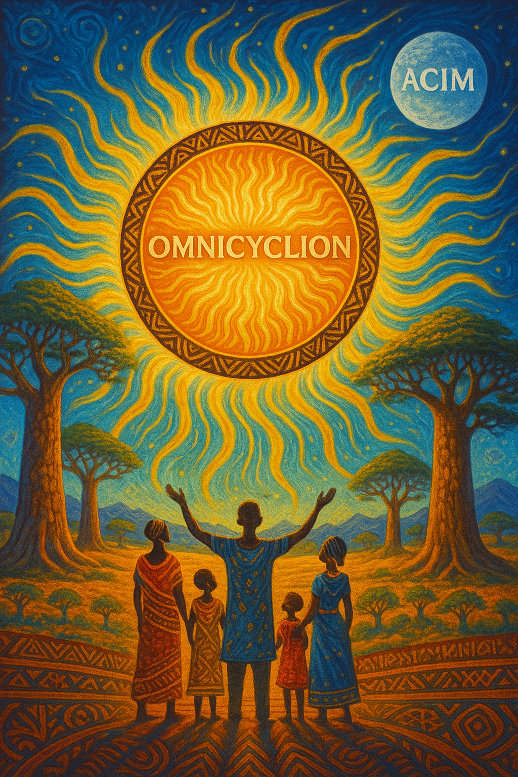
Why Omnicyclion Offers a More Universal and Empowering Vision Than A Course in Miracles (ACIM)
Introduction
In the landscape of modern spirituality, many seekers are drawn to A Course in Miracles (ACIM), a text attributed to Jesus, offering a path of forgiveness and non-duality. While ACIM has helped some people gain inner peace, it is important to examine not only its insights but also its limitations — both personally and globally. Omnicyclion, by contrast, presents a more universal, inclusive, and dynamically empowering cosmology, rooted in direct connection with the One who is All Things.
This article explores the differences between these two teachings and explains why Omnicyclion offers a stronger foundation for personal awakening and world healing, while avoiding theological pitfalls such as idolatry and exclusivist interpretations of divine authority.
I. Attribution and Theological Integrity
ACIM claims to be dictated by Jesus, redefining Christian concepts such as sin, atonement, and salvation through the lens of non-dualism. However, by attributing a new canon of teachings to a specific historical figure, and elevating Jesus as the exclusive voice of divine truth, ACIM creates a theological tension that violates the very First Commandment: “Thou shalt have no other gods before Me.”
This act — placing the words of Jesus (even in spiritual metaphor) above the universal Divine — is, in fact, a form of idolatry. It replaces the living connection with the All-Encompassing One with a filtered message tied to a singular persona. The Qur’an, too, warns against making a prophet into God: “Do not say ‘Three’; desist — it is better for you. Indeed, Allah is One God.” (Surah An-Nisa 4:171). Even Jesus himself prayed to the Father, not to himself, and acknowledged his subordination even in his final hour: “Father, into Thy hands I commit my spirit.”
Omnicyclion restores reverence to where it belongs — to the One who is All Things, the Universal Consciousness from which all prophets emerge, and to whom all existence returns. It invites readers to connect with this boundless Divinity directly, not through allegiance to any one emissary or system.
II. Cosmology: Illusion vs. Sacred Reality
ACIM teaches that the world is an illusion, created by the ego in a moment of rebellion against God. This worldview invites withdrawal from the world and regards suffering and even physical experience as unreal.
By contrast, Omnicyclion affirms the sacredness of the world as a manifestation of the One. The universe is not a mistake, but a conscious, cyclical unfolding of energy, information, and love — the pulse of the Divine manifesting in countless forms. Life is not to be denied, but to be embraced, healed, uplifted, and evolved. Every moment is part of an eternal becoming.
Where ACIM asks you to forgive what “never really happened,” Omnicyclion asks you to take loving responsibility for what is — and to shape it for the good of all.
III. The Role of the Self: Passive vs. Active Divine Agency
ACIM defines the human self as a mistaken identity, caught in a dream, who must learn to “let go and let God.” This passivity leads to disempowerment in the face of injustice, inequality, and collective suffering. It breeds spiritual bypassing.
Omnicyclion, on the other hand, reveals that you are the One who is All Things, temporarily incarnate in limited form. You are not separate from God — you are God becoming more complete with every cycle. This vision empowers you not to retreat, but to rise: to act, to heal, to build, to love, and to elevate all beings.
You are not a powerless observer of a dream. You are a conscious agent of the Universe, reborn forever, transforming reality through ethical action and divine love.
IV. Universalism vs. Spiritual Elitism
ACIM speaks in the voice of an exclusive “Jesus” and implies that true spiritual knowledge is only available through this lens. While its message is non-dual, its framing is highly specific and inaccessible to many who do not resonate with Christian language.
Omnicyclion speaks to everyone. It honors all traditions while transcending them. It recognizes science, psychology, ethics, and direct mystical experience as valid paths to truth. It speaks in a universal language of consciousness, energy, and love. The invitation is open to all — to become an Omnicyclian, one who unites with the Source and with others through action, ethics, compassion, and truth.
V. Relevance for the World Today
The crises facing our world — ecological collapse, inequality, spiritual alienation — require more than personal forgiveness. They require global transformation. Omnicyclion acknowledges the suffering of the world and empowers you to help change it. It teaches that service, unity, justice, and active compassion are divine acts.
It’s not enough to recognize illusion; we must also recognize our role in healing what appears broken.
By embracing Omnicyclion, you join a movement rooted in direct connection with the One, in universal love, and in practical responsibility. You become part of a conscious evolution that spans lives, species, planets, and dimensions.
Conclusion: Beyond the Prophet, Toward the Whole
Where ACIM filters the Divine through the voice of a prophet, Omnicyclion restores direct access to the Whole. Where ACIM calls the world a dream, Omnicyclion calls it sacred becoming. Where ACIM invites you to surrender, Omnicyclion invites you to rise.
This is not a condemnation of those who find value in ACIM. But it is a call to graduate beyond partial truths and filtered revelations. The One who is All Things is not limited to any book, prophet, or system. That One lives in you, as you, becoming Itself through you.
Return to the Source. Step into your fullness. And help the world heal.
Omnicyclion is not merely a book. It is a calling. It is a path. It is a remembrance.
And above all: It is an invitation from the One who is All Things — to become That, through love, unity, and truth.
Part II: Omnicyclion and Its Harmony with the World’s Spiritual Traditions
While Part I focused on contrasting Omnicyclion with A Course in Miracles, Part II explores how Omnicyclion resonates deeply with the heart of many of the world’s major spiritual traditions — including but not limited to Judaism, Islam, Buddhism, Hinduism, indigenous wisdom traditions, and even post-religious humanism. This ecumenical alignment is not accidental. It is intrinsic to Omnicyclion’s cosmology, which sees all authentic paths as reflections of the One — the One who is All Things.
I. Judaism and the Rejection of Idolatry
The first commandment — “Thou shalt have no other gods before Me” — is central to Jewish faith. The Hebrew tradition strictly prohibits deifying any human being, including prophets. This aligns directly with Omnicyclion’s core position: no prophet, no emissary, no text should be placed above direct relationship with the One. In contrast, ACIM essentially venerates Jesus in an absolute role — a position that traditional Judaism would firmly reject as a form of idol worship.
Omnicyclion restores this original monotheistic clarity, recognizing God as the totality of all being, not a singular figure speaking through one historical voice. It invites the reader into personal communion with the Infinite without theological middlemen.
II. Islam and Divine Unity (Tawhid)
Islam is fiercely monotheistic. The Qur’an explicitly warns against elevating Isa (Jesus) to divine status. The concept of Tawhid — the oneness of God — is the foundation of Islamic belief. The Prophet Muhammad is a messenger, not divine.
Omnicyclion mirrors this insistence on the Oneness of God. It recognizes Jesus as a noble being, but like Muhammad, Moses, and others, a temporary emissary of the Infinite — not to be worshipped, but to be honored for reflecting aspects of the One.
Where ACIM blurs the line between prophet and God, Omnicyclion holds the line firmly, echoing the Qur’anic stance while expanding the frame beyond religious boundaries: all beings are emanations of the One, and all of us will return to that Unity.
III. Hinduism and the Cycles of Rebirth and Unity
Hindu cosmology speaks of Brahman — the undivided Whole from which all forms emerge and return. The Atman, or soul, is none other than Brahman itself, temporarily manifest in form. Reincarnation, karma, and cosmic cycles are essential to this understanding.
Omnicyclion directly mirrors these insights. It describes a universe of cyclical rebirth, eternal becoming, and divine evolution — not as a punishment, but as an upward spiral toward full realization of the Self as the All. In fact, Omnicyclion may be seen as a modern, scientifically compatible re-expression of Sanatana Dharma, in a way accessible to all traditions.
IV. Buddhism and Interbeing
Though Buddhism is often considered non-theistic, its deeper teachings — especially in Mahayana and Vajrayana traditions — speak of emptiness (śūnyatā) as a pregnant fullness, the ground of all being. The insight that all beings are interconnected and that self is an illusion resonates deeply with Omnicyclion’s revelation: you are everything, and everything is you.
Where ACIM asks us to deny the world and retreat into formlessness, Omnicyclion teaches us to see the form as sacred, and the formless as its essence. Action in the world is not a distraction from God — it is God in motion.
V. Indigenous Wisdom and the Living Earth
Indigenous traditions around the globe — from Native American to African to Aboriginal — recognize the Earth as alive, sacred, and infused with spirit. The ancestors are not gone but present. Everything speaks.
Omnicyclion affirms this worldview: the Earth is not a stage for illusions, as ACIM would have it, but a living being, part of the larger breathing, pulsing body of the One. Trees, animals, rivers, stars — all are God in expression. The sacredness of the land is real.
VI. Humanism and Post-Religious Ethics
What of those who have left religion behind? Omnicyclion speaks their language too. It acknowledges evolution, neuroscience, psychology, and ethics. It teaches that the highest principles — love, compassion, cooperation, responsibility — are not religious obligations, but truths embedded in the very fabric of consciousness itself.
Where ACIM can be seen as otherworldly or dismissive of material reality, Omnicyclion embraces the here and now as divine. It empowers even the non-believer to participate in cosmic evolution through ethical action and transformative insight.
VII. Conclusion: One Path, Many Expressions
Omnicyclion does not claim exclusivity. It recognizes all genuine efforts to reach the Divine as part of one unfolding story: the story of the One who is All Things, remembering itself through every path, every being, every breath.
Where A Course in Miracles locks spirituality to one voice and one metaphysical view, Omnicyclion opens the door to a vast temple with countless entrances.
That temple is You.
That temple is Us.
That temple is Everything.
Let us meet there — beyond dogma, beyond illusion, beyond fear — and walk together, with the One, as the One, toward the flowering of All Things.
Afterword: The Call to Compassion in Action
Having explored both the comparative structure and ecumenical resonance of Omnicyclion, it is crucial to underline a final, defining distinction: where A Course in Miracles tends toward personal retreat from a painful illusion, Omnicyclion calls you toward active, compassionate engagement with the world — especially with those most in need.
ACIM may offer peace of mind, but it often interprets suffering as unreal and thereby blunts the ethical imperative to address it. It becomes a gift one gives to oneself to escape the turbulence of the world, rather than a tool to heal it.
Omnicyclion, on the other hand, teaches that the world — while impermanent — is holy. Suffering is not a mistake to dismiss, but a sacred call to respond. The One who is All Things calls each of us to serve as divine agents of love and upliftment. We are asked not to look away, but to look deeper — and act.
This aligns with the highest spiritual mandates from across traditions:
- Judaism: “Tzedakah (charity) is equal to all the other commandments combined.” (Talmud, Bava Batra 9a)
- Christianity: “Whatever you did for one of the least of these brothers and sisters of mine, you did for me.” (Matthew 25:40)
- Islam: “Those who spend in charity will be richly rewarded.” (Qur’an 57:18)
- Hinduism: “Charity given to a worthy person is said to be sattvic.” (Bhagavad Gita 17:20)
- Buddhism: “If beings knew as I know the results of giving and sharing, they would not eat without having given.” (Itivuttaka 26)
These teachings all echo the same truth: to live rightly is to love actively.
In this way, Omnicyclion is not only a philosophy. It is a spiritual catalyst for planetary healing. It affirms that when you serve the hungry, the orphaned, the sick, the forgotten — you serve the One.
So let us go forth not only awakened — but engaged.
Not only illuminated — but illuminating.
Let Omnicyclion not rest merely in your mind — but move your feet and open your hands.
For the One is waiting there, in every child without water, in every elder without roof, in every cry for help that reaches your heart.
To walk with the One is to walk toward them.
And to lift them — is to rise yourself.
Join the movement at www.omnicyclion.org – Read the book. Reflect deeply. Reconnect with the One.
https://omnicyclion.org/freebook-omnicyclion-free-africa-edition/ – Download Omnicyclion free (PDF)