Xōchipilli — Prince of Flowers
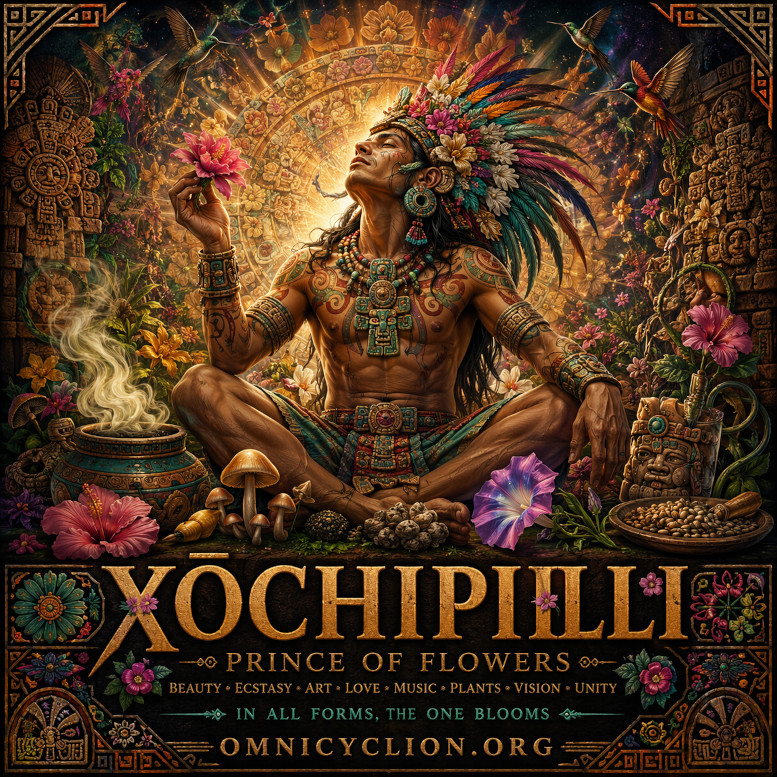
Ecstasy, Beauty, and the Divine Bloom of the One – Omnicyclion.org salutes you!


There are moments, when studying the sacred traditions of humanity, where the veil thins—not through abstraction, but through startling, embodied clarity. The presence of Xōchipilli is one of those moments. He does not whisper from the margins. He radiates. He blooms. He intoxicates. He reveals.
Known as the “Prince of Flowers,” Xōchipilli stands within the Mexica (Aztec) cosmology as a deity of art, beauty, music, eroticism, dance, and—most strikingly—entheogenic ecstasy. His is not a restrained divinity. His is a divinity of overflow. Of blossoming. Of the irresistible flowering of consciousness into color, sensation, and unity.
And within the lens of Omnicyclion, we recognize Him not as “other,” but as a face—one expression—of the One that is All.
The Sacred Body as Temple and Instrument
Xōchipilli is often depicted seated, head tilted upward, eyes half-closed—not in sleep, but in transcendence. His body is adorned with carvings of sacred plants: unmistakable botanical signatures of psychoactive allies. Among them are:
- Teonanácatl — “flesh of the gods,” the sacred mushrooms that dissolve boundaries and reveal unity.
- Ololiuqui — seeds containing vision-inducing alkaloids, opening inner landscapes.
- Tobacco, cacao, and other ritual plants—each a key, each a doorway.
These were not “drugs” in the modern, reductionist sense. They were sacraments. Technologies of communion. Bridges between the individual mind and the infinite field of consciousness.
Xōchipilli does not merely permit this exploration—He embodies it. He is the ecstatic state itself. The moment where perception liquefies into awe. Where the self dissolves into the All.
Eroticism Without Shame — Love Without Division
Equally essential—and often quietly omitted in sanitized retellings—is Xōchipilli’s association with sexuality in its full spectrum, including homosexuality. Within his domain, desire is not something to suppress or moralize. It is something to understand, refine, and ultimately transcend through integration.
Here, Omnicyclion stands in recognition, not in hesitation.
Because if All is One, then every authentic expression of love—between beings who are, in truth, expressions of the same Source—is already contained within the Divine. Not all expressions are equally wise or coherent, but none exist outside the field of the One.
Xōchipilli’s domain reminds us:
- The body is not an obstacle—it is an instrument.
- Desire is not an enemy—it is energy.
- Expression is not corruption—it is revelation in motion.
When approached consciously, sexuality becomes not indulgence, but alignment. Not fragmentation, but union. Not escape, but return.
Ecstasy as a Path — Not an Accident
In many traditions, transcendence is framed as ascetic withdrawal. Silence. Stillness. Detachment.
Xōchipilli offers another axis:
Transcendence through intensity. Through beauty. Through overwhelming presence.
Music that dissolves the boundary between listener and sound.
Dance that erases the distinction between mover and movement.
Plants that reveal the illusion of separateness.
Love that expands identity beyond the skin.
This is not chaos. It is a different kind of order—a flowering order.
And yet, Omnicyclion does not romanticize without discernment. Every doorway demands responsibility. Every expansion demands integration. The same force that liberates can destabilize if approached without grounding.
Thus, the teaching is not “lose yourself blindly,” but:
Know what you are touching. Know what you are becoming.
Xōchipilli Within Omnicyclion
Within the Omnicyclion framework—the evolving lens of the One experiencing itself through all forms—Xōchipilli is unmistakably one of the radiant facets of the Divine Totality.
He represents:
- The ecstatic intelligence of the universe
- The aesthetic dimension of truth
- The integration of body, mind, and spirit
- The courage to embrace what is unfamiliar
Omnicyclion does not flatten differences. It does not erase the strange, the intense, or the culturally distant.
It says instead:
“Look closer.”
“Understand deeper.”
“Integrate wisely.”
Because the Universe does not express itself only in what is comfortable. It expresses itself in everything—including what challenges, expands, or unsettles us.
The Flower That Blooms Everywhere
To encounter Xōchipilli is to be confronted with a question:
Can you accept that the Divine expresses itself not only in order, but in ecstasy?
Not only in restraint, but in overflow?
Not only in clarity, but in altered states that dissolve the illusion of separation?
If the answer is yes—even cautiously—then something begins to open.
A softening.
A curiosity.
A willingness to let reality be larger than previously assumed.
And that is where Omnicyclion lives.
Not in rigid belief, but in expanding coherence.
Not in denial, but in integration.
Not in fear of the unfamiliar, but in the disciplined embrace of it—so that it may be understood, refined, and aligned with the greater Whole.
Closing Invocation
Xōchipilli, Prince of Flowers—
You who sit at the threshold between form and dissolution,
Between beauty and transcendence,
Between sensation and unity—
Omnicyclion recognizes You.
Not as separate. Not as distant.
But as one of the many faces through which the One reveals itself.
May we approach Your domain with awareness.
May we honor its power without losing our grounding.
May we learn from its intensity without becoming fragmented by it.
And above all—
May we remember:
ALL IS ONE — I AM THAT — I AM PURE LOVE
Even in the bloom.
Even in the ecstasy.
Even in the unknown.