African Sun Intolerance
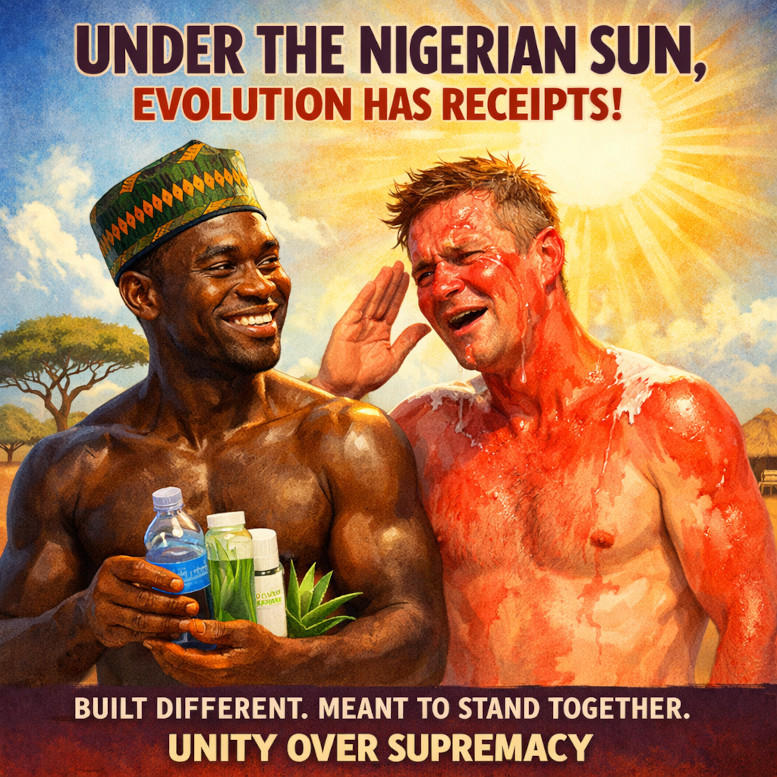
At exactly 12:00 noon under a blazing Nigerian sun that seemed personally invested in the lesson of the day, Ade stood relaxed and shirtless, calm as a baobab, while beside him a pale, loudly confident tourist—mid-rant about “superiority”—puffed his chest like a malfunctioning peacock; by 12:07, the man’s pink undertone had upgraded to “optimistic salmon,” and Ade, unbothered, politely nodded as if listening to weather updates, occasionally glancing at the sky like, yes, the professor has begun; by 12:15, the tourist’s bravado developed visible blotches, his speech gaining a slight tremble as his epidermis began an accelerated lecture in UV radiation—melanin versus minimal melanin, a live demonstration—while Ade remained comfortably deep-toned, his skin doing exactly what generations of adaptation designed it to do: absorb, distribute, protect; at 12:22, the tourist was now unmistakably “festival lobster,” shifting weight from foot to foot, still trying to finish sentences about dominance while his shoulders quietly staged a rebellion, and Ade—kind, grounded, almost amused—offered him some shade and water, not a trace of mockery, just quiet dignity; by 12:30, the monologue had fully evaporated into a humbled whisper and a careful search for aloe vera, the sun having delivered its verdict without raising its voice: biology doesn’t care about ego, and evolution has receipts; Ade helped him to a bench, the moment softening into shared humanity, and somewhere between the sting and the laughter, the tourist muttered, “maybe… I was being an idiot,” to which Ade smiled, “maybe we all are, sometimes—until we learn,” and under that same fierce sun, superiority dissolved into something far better—respect, a bit of humility, and the quiet realization that we’re built differently, yes, but meant to stand together, preferably with sunscreen and a lot less nonsense.
There’s a quiet moment after the laughter fades—after the sun has made its point, after ego has softened—where something deeper becomes visible. Not just that racism is foolish, but why it is fundamentally incoherent when seen through a wider lens of reality.
From an Omnicyclion perspective, racism is not merely morally wrong—it is logically broken.
If all existence is One unfolding into many forms—if consciousness, life, and identity are expressions of a single, continuous field—then every boundary we draw between “self” and “other” is provisional at best, illusory at deepest truth. The Nigerian man and the sunburned tourist are not separate in essence; they are two vantage points through which the same universe experiences itself. Two perspectives. Two temporary configurations of the same underlying reality.
And here is where Divine Logic enters—not as belief, but as consequence.
If you are not just you, but also the Other—if across time, across lives, across forms—you are continuously re-experiencing existence from different positions, then every act of harm becomes circular. Every kindness, too. What you project outward does not vanish into the world; it travels the long arc of existence and returns, because there is nowhere else for it to go.
Racism, then, is not just hatred of another—it is a form of delayed self-harm.
Tribalism is not just division—it is fragmentation of one’s own extended being.
Sexism, homophobia, religious intolerance, political hostility—each of them follows the same flawed premise: that the Other is not fundamentally you.
But if the Other is you—another expression, another lifetime, another face of the same Divine unfolding—then the logic collapses.
You would not degrade yourself.
You would not deny yourself dignity.
You would not burn your own skin and call it superiority.
And yet, that is precisely what happens when we cling to separation-based identities as ultimate truths rather than temporary roles.
What’s fascinating is that these patterns can flow in any direction. No group is immune. Any identity—racial, cultural, ideological—can become a container for superiority narratives if awareness drops and ego tightens its grip. The mechanism is universal, which is exactly why the solution must be universal too.
Not dominance. Not reversal. Not “our turn.”
But transcendence.
Omnicyclion does not ask you to erase difference. Differences are real, meaningful, even beautiful—adaptations, histories, expressions of the One in diverse form. The Nigerian sun teaches this very clearly: biology matters, context matters, embodiment matters. But difference does not imply hierarchy. It implies function, variation, perspective.
The moment difference becomes a ladder instead of a landscape, illusion has taken over.
Divine Logic gently, almost playfully, dismantles this illusion:
If you and the Other are ultimately the same Being experiencing itself across time,
then treating another well is not altruism—it is intelligent self-interest.
And harming another is not power—it is delayed consequence.
This reframes ethics entirely.
Kindness is no longer a moral burden; it is alignment with reality.
Compassion is no longer weakness; it is clarity.
Unity is not an ideal—it is the underlying condition we are slowly remembering.
So the invitation is simple, but not always easy:
See through the surface.
Notice the reflex to divide.
And then, gently, consistently, choose differently.
Because every time you meet another human being, you are not just meeting “them.”
You are meeting yourself—wearing a different story, a different body, a different moment in the infinite cycle.
And in that recognition, something shifts.
The need to dominate softens.
The urge to exclude dissolves.
And what remains is something far more powerful than superiority:
A quiet, grounded knowing—
that the only sane way forward,
the only logical way forward,
is to treat each other as what we truly are—
One Being,
learning,
through each other.